
The Kasbah. Agadir, formerly "Santa Cruz", is located on a seismic line. Agadir was rebuilt after the 1960 earthquake that killed 17000 people and destroyed 60 percent of this city. More about our visit to this former French colony, in today's post.
NEW: The audio section has moved and is now a dual-recording. Jean-Marc pronounces the French and you'll hear my Arizona accent for the English! To access the French/English sound-file, scroll to the vocabulary section. Reading via email? You will need to click over to the website for the full edition.
TODAY’S FRENCH WORD: se ressaisir
: to pull yourself together, to buck up
A DAY IN A FRENCH LIFE by Kristi Espinasse
I love the slightly old-fashioned expression “to buck up” and its various definitions:
To buck up is to become encouraged, reinvigorated. To pluck up courage. To improve, smarten, to raise the morale of, to cheer up… In French, to buck up could be translated to se ressaisir.
After selling his wine shop, and following his last day as a business owner and gérant, Jean-Marc wanted to travel somewhere warm and sunny for some renewal and cheer. He finally settled on Agadir, Morocco–a 3-hr direct flight from nearby Marseilles.
By Sunday morning we were walking along an exotic beach when my husband turned to look at the giant, white-tipped vagues which draw so many surfers to the area.“I wonder if la mer is warmer here?”
“The sea?” I grin, but it’s too late, he can’t take it back. And now it’s my turn to have a little fun with Jean-Marc:
“But this is not the sea! It's the ocean.”
How my spouse loves to correct tourists who visit our own station balnéaire, who innocently confuse the sea and the ocean as I often did. But here, on vacation in North Africa, it must be the relaxed state he is in that’s caused the confusion. “Oui, l’océan!” Jean-Marc smiles. "Je sais. Je sais."
“But do you know the difference between the ocean and the sea?” Quizzes Monsieur Smartypants, only to answer his own question: "Une mer est entourée de terre…a sea is surrounded by land.”
"I know, I know." But the truth is I'm just scraping by when it comes to geography. Witness this letter I received from a reader, following my previous post: Richard writes: “A lovely story, but if you were in Agadir, the sun was setting in the Atlantic, not the Mediterranean!”
Oups! The funny part is both Jean-Marc and I missed the error when proofreading the essay.
Here on Agadir plage, on the Atlantic, the beach is so wide and deep and smooth the locals play soccer on the endless sandy field. The sun is rising when a young man with a stick draws a large rectangle over le sable. The rectangles extend down the plage for a half kilometer as a dozen or more teams enjoy early morning practice.
There are a few other women walking on the beach at this early hour. Their heads and sometimes faces are covered with scarves. Up on the hotel terraces overlooking the shoreline, bikini-clad tourists (mostly French) will soon be sunning themselves. Just when I'm feeling super foreign, I notice the soccer players are all playing ball dans leurs chaussettes! As a mom, I can suddenly relate to their moms, who are not going to be happy on laundry day. As exotic as the women here look to me, we are all dealing with the “outdoor sock issue” back home.
Back in our hotel room overlooking the pool and the sea—l’océan—I am tugging at the one-piece bathing suit I’ve ordered online. Yay, it fits…even if it doesn’t fit in with the barely-clad Frenchies. I take that back. It looks like more French women are wearing one pieces….
I’ve settled in poolside when another woman arrives. She sets her beach bag down four chairs away from mine. When she removes her paréo, I see she’s wearing the same black one-piece as me. I reconsider walking past my sosie to get to the pool stairs, where I was headed for a swim. Oh buck up! I think instead. I’m tired of hiding from everything and everybody. Vive la liberté! Freedom calls!
Only, the water in the heated pool is not as warm as the “piscine chauffé” sign would lead one to believe. It is so cold that I regret I didn't follow my husband who just dove into the sea. I mean the ocean. Oh, you know what I mean!
I leave you with my favorite English verb, to buck up. For the rest of this year, I will be practicing it–even if I never did buck up and dive into… l'Atlantique!
***
That's me being taken for a ride–in both senses. I could have ridden this sweet horse forever, this gentle cheval erased all my fears… for the brief moment we were together. (The unsolicited ride began "for free" and ended up costing a Moroccan day's salary. Thankfully, the berger and the tourist came to a settlement wherein each left with their dignity intact.
Remember the soccer players? Those are socks–and not shoes–on their feet. Ouch! They also kick the ball barefoot!
Part of the panoramic view from the Kasbah.
BOOKS: The Conquest of Morocco
"…in the mad scramble for African colonies, Morocco had one great attraction for the Europeans: it was available. In 1903, France undertook to conquer the exotic and backward country. By the time World War I broke out the conquest was virtually complete." –from "The Conquest of Morocco"
FRENCH VOCABULARY
se ressaisir = to buck up
le/la gérant(e) = manager
la vague = wave
la station balnéaire = coastal resort, seaside resort
l’océan (m) = ocean
je sais = I know
une mer est entourée de terre = a sea is surrounded by land
oups = whoops
le sable = sand
la plage = beach
dans leurs chaussettes = in their socks
le paréo = beach cover up
le sosie = twin
vive la liberté = long live freedom
la piscine chauffée = heated pool
l’atlantique = the Atlantic
AUDIO FILE & SOME HISTORY
Following the vocabulary list, there is a pause in the recording. Then you will hear the sentence below. (I get a little tongue-tied toward the end!) Do you enjoy these husband/wife recordings? Let us know.
Click here to listen to Jean-Marc and me pronounce the French and English
La langue française fait partie de la vie quotidienne des Marocains. C’est un héritage d’une période de colonisation durant laquelle elle avait même été proclamée langue officielle des institutions coloniales. Aujourd’hui encore, plus d’un demi-siècle après l’indépendance du pays, la langue française reste très répandue au Maroc, notamment dans les secteurs des entreprises privées et de l’éducation. (credit: LeMatin.ma)
The French language is part of the daily life of Moroccans. It is a legacy of a period of colonization during which it was even proclaimed the official language of colonial institutions. Even today, more than half a century after the country's independence, the French language remains widespread in Morocco, particularly in the private business and education sectors.
The handwriting from 1913 reads "north-east side is camp of the riflemen. What else can you say about this postcard? Share your history knowledge in the comments section and add to this post. Merci!
SWEET OF THE WEEK, NO 8: North African pastries, made by our Algerian friends (thanks Sidi and Sidi's mom who made them). Here's a Makroud, a baklava (my favorite!) and a corne de gazelle. So delicious and satisfying with or without mint tea. Ants love them too so don't hide them in your nightstand.
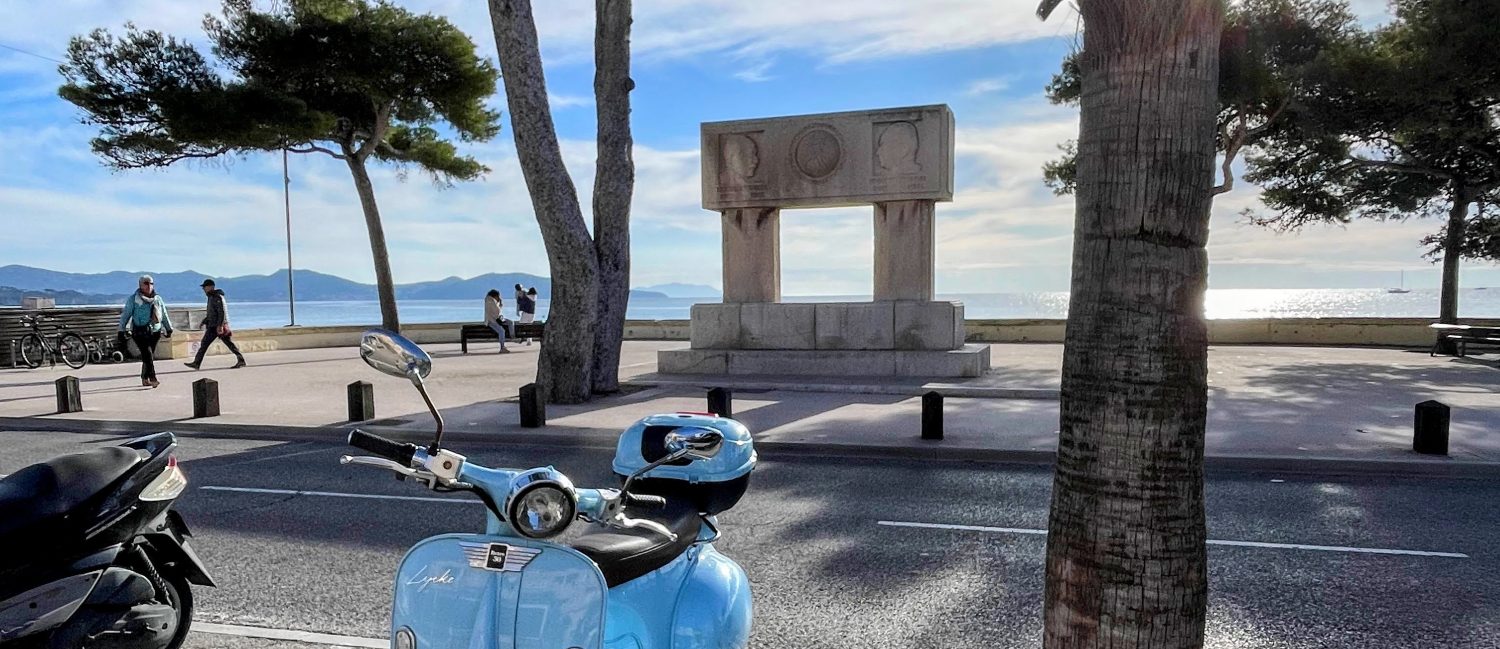
January sunrise. From shore to shore. From surfers to paddle-boarders. After the ocean in Agadir, here is the sea in La Ciotat, near Cassis. Please check out the book list in the side column (or end) of this blog. New books have been added.
Discover more from French Word-A-Day
Subscribe to get the latest posts sent to your email.
Thank you for all the gorgeous photos and sharing your visit with Jean-Marc to Morocco. It seems so exotic, yet I could speak French there. Formidable! Living vicariously has its perks, n’est-ce pas?
Great pictures! I especially liked the photo of the camel with a “toaster cover.” Is that to keep the camel cool or the saddle clean?
Love the photos . i’ve never ever heard the expresssion « to buck up ». Maybe it’s regional ?
I really love both of your voices, each so unique.
Thank you, Leslie! I am not keen on listening to my recorded voice. But I will buck up and record anyway 🙂
Merci, encore. I love your posts. They are so interesting and educational and are helping me slowly improve my French vocabulary what there is of it. P.S. I live in Arizona now.
Hi Kristy, I love this story and all of them really. Always pleased to see an email from you pop up in my in-box.
“Buck up” is going to be my phrase-of-the-day for the next few months, as change is in the wind for me too.
I did, however, notice that your blog post uses the incorrect form of here / hear in the AUDIO FILE & SOME HISTORY section.
Great post as always……..fun on the beach……………can’t beat it!
Hi,Kristi,
My grandfather was born in Cairo, Egypt. His mother, my great grandmother whom I never met because she died young, was a housekeeper for her brother who was a French Parisian colonial diplomat in North Africa. She met my great-grandfather, another Frenchman, and had my grandfather. Her early death precipitated my grandfather’s immigration to the United States. I have a beautiful photo of a handsome Frenchman with a stunning handlebar mustache dressed in a long coat and wearing a Moroccan fez (the French had a felt enterprise in Morocco). My own conjecture is that my grandfather’s great love of all things French came out of an unresolved grief for the love of his French mother. I grew up very immersed in the love of the French culture and Mediterranean and Moroccan food. I have long desired to travel to this area, but now you have allowed me a vicarious adventure to the country of my forbears. Merci beaucoup.
I love hearing your voice too, Kristi. Nice addition to your stories. And Marc, I always love hearing your voice speaking French, the most seductive of languages! Hugs
Hi Kristi
Always enjoy reading your interesting posts.
You showed a postcard and asked for comments. It rang a few bells with me. The card is stamped ‘2e Regiment de Marche de Zouaves au Maroc.’ Second Zouaves Infantry Regiment in Morocco. The Zouaves were French soldiers recruited in Oran and Western Algeria when Algeria was a French colony. They had a long history from 1831 until their disbandment in 1962. They fought in many wars, including World War 1. They wore a distinctive uniform which included baggy trousers, sashes and a fez-like headgear.
France often recruited soldiers from their colonies. I remember seeing a detachment of another such regiment, the Spahis, taking part on horses in the Edinburgh Military Tattoo. The Regiment still exists and nowadays is part of the modern French Army. The soldiers wear distinctive long, hooded white cloaks over their uniforms and are often seen in the annual Bastille Day parades in Paris.
I apologise for this long-winded post, but you did ask for history comments!
Kristin, I’ve always wanted to ask what is the primary language that you speak at home in France within your family?
I actually prefer just hearing Jean-Marc read the French words because then I can challenge myself to see if I understand them. Afterwards, I check your blog to see if I was right or not.
Love it as always, thank you Kristin for your continued journey and effort to educate those of us that are Francophiles when we travel. Love and blessings to you and family for the Pacific Coast. Jimm
Any sign of Ilsa and Victor Lazlo at Rick’s Cafe Americaine? I can’t imagine Morocco without thinking of the classic film “Casablanca”
“Here’s looking at you kid,” in your stunning one-piece maillot de bain.
Thank you for catching the mistake, Mary. I will fix it now. And bon courage for the changes ahead of you.
Thank you, Nicholas! I enjoyed learning about the Zouaves and the various regiments. I had never heard about them or their unique uniform, but now that you mention them I remember seeing these uniforms (in the past, in photos). Every since reading Ruth Hartz’s book, I have been meaning to learn more about another group: The French Foreign Legion.
Hi Lynne, Thanks for asking. We speak both languages. Unfortunately, we speak a lot of franglais, too! It all depends on who begins speaking first. Then the rest follow suit. Grandma Jules speaks only English, but has no problem communicating with locals, in heart language.
Lovely post! I am happy to know you got away for a little break after selling the wine shop. No matter the ocean or sea, it’s always soothing to look out over the water. I don’t know much about the Kasbah except the song, ha! My sons and grandsons just rode the camels at the zoo here in Phoenix and the animals intrigued us all. That last photo of the sunrise encourages me to buck up despite life’s current challenges! ❤️
Ma vie est maintenant complète! I have been quoted in one of your stories. Merci, Kristi!
If the Zouaves and the Spahis interest you, I can heartily recommend “Le Roman d’un spahi,” by Pierre Loti. Written in 1881, it is the bittersweet story of a romance between a French soldier and a Senegalese woman.
Thank you, Richard, for your kind words and for the book recommendation. I will check it out! Bon weekend.
Thank You so much! Your posts are so insightful. The only thing I am still lost about is that I wish I had the same text in French as well so that I am able to translate it vice versa and thus boost my French.
Dear Kristi,
So fun to catch up on your post while sitting in Saint Raphael, around the corner on the Cote d’Azur where we are wintering for a couple of months. AND there is a bottle of white wine “Les Canisses”from Bandol which was lovely with tonight’s chicken. We’ve been here a week and learned many new words already, in addition to those remembered from our studies 50 plus years ago–before computers, so that’s one batch of vocabulaire right there!
Like you and J-M, we fled to somewhere warmer.
Mara