
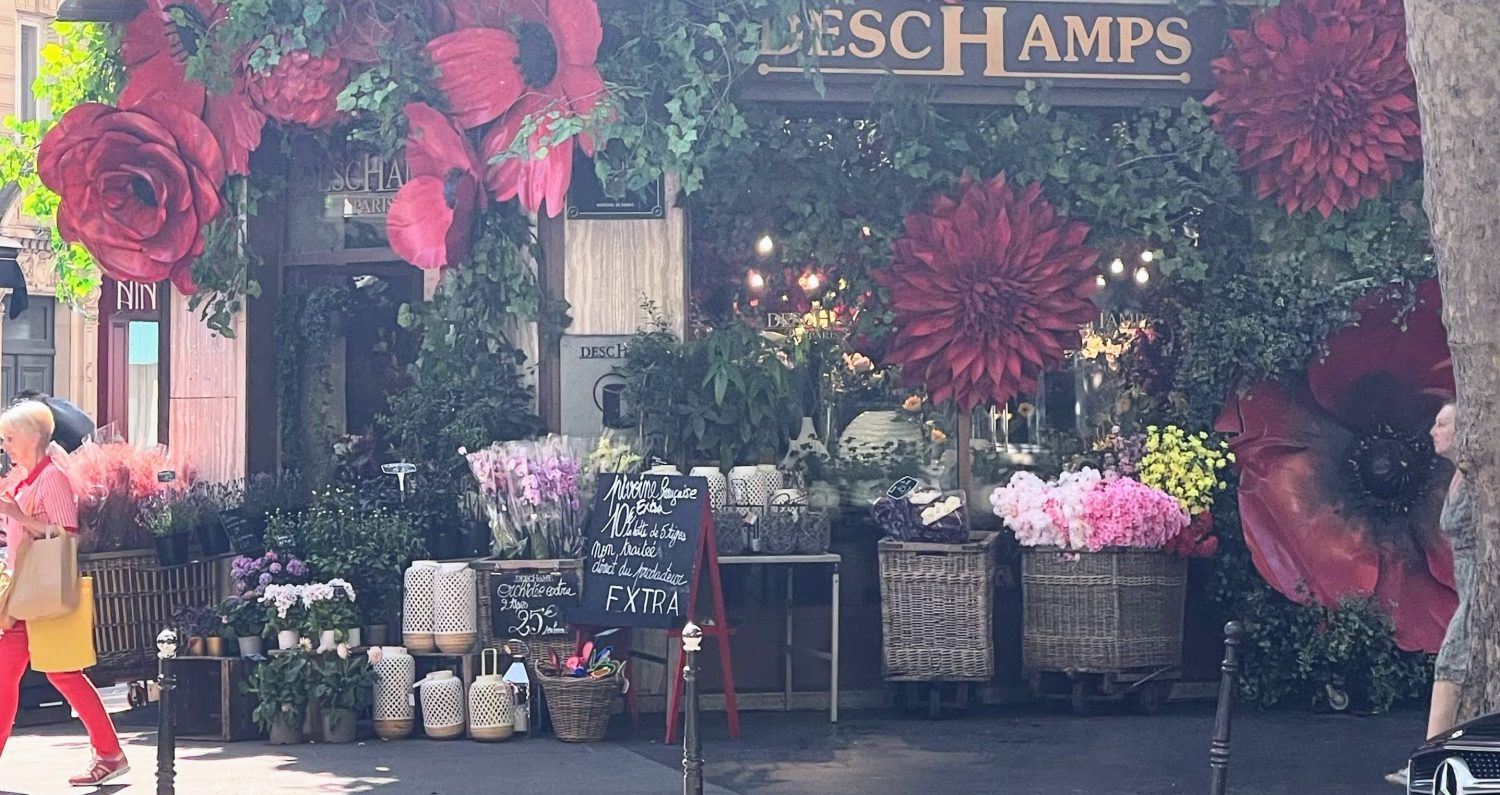
No, the street light and the window are not false friends, but keep each other quiet company on a lazy midsummer day in the South of France.
les faux amis (lay fowz ah mee)
: "false friends" or words that look alike… but have different meanings
.
Audio File & Example sentence:
Listen to my daughter Jackie, her friend Manu, and me… pronounce these French words: Download MP3 file
Les Faux Amis!
Dans la vie, la plupart de nos amis sont des vrais amis, mais c'est les faux amis qui nous déçoivent. In life, most of our friends are true friends, but it's the false friends who deceive us. –Tim Averill
On Wednesday I told you about my very *spéciale* family… and a certain faux amis that was rendering them insane … en tout cas* to the French.
I was inspired to write that story after Tim Averill (whom we met in Gary's pétanque post) shared with me a list of faux amis.
Tim is here today ("here" in a very façon de parler*/manner-of-speaking way, for Tim is currently in Massachusetts–but more about Tim in the bio below)… as I was saying, Tim is here (sort of… à peu près*) to share his list of faux amis with you. Enjoy it, share it, and help grow it by adding to Tim's list of "false friends"!
Tim's List of Faux Amis
Faux amis are cognates that are deceptive because they do not have the same meaning in English and in French, even though they have the same or very similar orthography. Have a look at these:
sensible = sensitive (français*) wise and pragmatic (anglais*)
location = rental (fr) place (ang)
affair(e) = business (fr) sexual infidelity (ang)
vase = mud, silt (fr) container (ang)
versatile = fickle (fr) multi talented (ang)
blesser = injure/wound (fr) bless (ang)
chair = flesh (fr) seat (ang)
college = lycée (fr) university (eng)
Tim adds: Dans la vie, la plupart de nos amis sont des vrais amis, mais c'est les faux amis qui nous déçoivent. C'est la même chose entre les langues 🙂
***
Tim Averill is a teacher at "Ecole Bilingue de Beverly," also known as Waring School. He first spent a year in France in 1967-68 at "L'Universite de Bordeaux," and is an avid francophile. Both personally and professionally, he enjoys travels in France. Waring School has an annual exchange with Lycée David D'Angers and Tim and his artist wife Lauren travel to Provence as frequently as possible. The highlight of Tim's most recent trip was a visit to Domaine Rouge-Bleu and the chance to taste the wines of Jean Marc and to meet Kristin.
* * *
Chow,*
Kristin
*looks as though Italian might have its share of false friends, too (dog/food/goodbye?) …never mind my spelling.
~~~~~~~~~French Vocabulary~~~~~~~~
en tout cas = in any case; façon de parler = so to speak; à peu près = almost, more or less; le français (m) = French; l'anglais (m) = English; le bât (m) = packsaddle
Forget faux amis for a moment and enjoy these true friends from Villedieu.
Discover more from French Word-A-Day
Subscribe to get the latest posts sent to your email.
Loved the man and cats picture!
Merci, Claudette! The man’s name is Ulysse and he has asked for a copy of the photo. Thanks for the indirect reminder 🙂
The most embarrassing “faux amis” is:
preservative / preservatif
Here are my faux amis from my many times (and thus many years) studying French:
actuellement: doesn’t mean actually, but currently
demander: has a “softer” meaning in French as in to ask for
entreé: the American usage is the opposite from the French meaning appetizer
librairie: a French bookstore versus an English library
gentil: this one always gives me the wrong impression of somebody in French literature, I always think of the person as gentle like a lamb when the French meant nice or kind
raisin: if the French means grape, where did the English come up with raisin as a dried grape?
coin: has nothing to do with money, but is merely a corner
blesser: has nothing to do with blessing, but with wounding or injuring
unique: this shows one of the things I love about French but don’t always remember which meaning comes from which placement, before a French noun means “only”, after the noun unique (yes, I had to look up which was which) (the French grand is one I can never remember which meaning comes from which placement)
and last, one that got me totally embarrassed in a French class and, you can look up the meaning yourself, was napkin, such an unobvious meaning for a male.
A few faux-amis that come to mind:
une camera – only a movie camera; a “regular” camera is “un appareil de photo”
une batterie – only a car battery; regular batteries are “piles.”
Another meaning of “pile” is “tails”, as in flipping a coin. Along with it, “face” is not “face,” but (in this context), “heads.”
La “galerie” can be a luggage rack on a car.
I’ll send more if I think of them.
Bill –
“Actuellement” (or “actuel/le,” meaning current) has a partner.
ancien/ne = former
I still get stuck for a half-second when I hear about l’ancien champion du monde (He doesn’t look that old.) or l’actuel ministre du défense (Is there an imposter out there?).
Your “eliminating condoms from the menus” comment reminded me of a story I have recently read:
http://www.ocregister.com/articles/hodousek-lawsuit-restaurant-2505680-condom-jumper
Thanks, Bruce. Yes, I forgot about ancien/ne and I have that same hesitation when I see ancien before the brain kicks in (or kicks me) and I remember that, as you said, it means former.
I had also forgotten about preservatif but remember now that it was a word I was going to avoid knowing that I’d probably end up using it in the wrong context.
(Who was in charge of bringing these words into English anyway??)
don’t forget that word meanings can change when there is a masculine and feminine form: le vase is not a faux ami while la vase (as noted in today’s article) is.
I enjoyed these, particularly having taught French for 35 years! Others that I was witness to often were:
attendre – meaning “to wait for” in French as opposed to “to attend” in English, which is “assister à in French! And to express the meaning of “assist (help someone), in French the verb “aider” is used. Clear ?!?!?
Then there is the word, ‘un avertissement” which is “a warning” in English, not an advertisement, which is “La publicité” often referred to as “la pub” (with the French pronounced “u”, not like in the English word “pub”!
My last one for the time being is “le caractère, which is not a character in a book, film, etc. but means your inner being, that kind of character. The French word “personnage” is used to talk about characters in films, books, etc.
For “ancien” where it is placed in its position to the noun it is describing determines the meaning. Un ancien prof, is a former one, “un prof ancien” is a very old one :>)
Explanation, please. In a similar sentence I would have said “… ce sont les faux amis qui nous déçoivent”. Is “c’est” + plural noun an idiomatic usage, and would “ce sont” be plain wrong or correct but regarded as stiff or typical of foreigner French? Merci a qui m’explique.
Saul Rosenthal has put together a whole book of Faux Amis that you may want to see at http://www.amazon.com/French-Faux-Amis-Combined-Book/dp/1604942207/ref=sr_1_3?ie=UTF8&qid=1248441375&sr=8-3
He does a terrific job of explaining the different meanings with thoughts on how they might have diverged.
Don’t forget La verge verge/penis. Quite reasonable that the french noun should be female …..
I get confused by ‘Solde’ on market tickets, thinking it means ‘sold’, rather than ‘special offer (?)’.
Shouldn’t “decevoir” be translated as “disappoint” rather than “deceive”? (A faux ami of a sort, in itself)
Then there’s:
assister – to attend (as in a meeting)
Candy, Minneapolis
I’ll have to be sure never to say “Mettez les fleurs dans la vase.”!!
Thank you, Tim.
Oops. Now I see that Jackie already addressed assister and was more correct to say “assister à.”
Please someone respond to Passante, parce qu’il pose une très bonne question…
Faux amis is a GREAT subject for us right now as we are currently hosting a young woman (17 yr.s) from France on an exchange program for the next few weeks! It has been a wonderful opportunity to brush up on my French! Delphine is from a town near Marsailles called Martigues. She is quite fluent in English and so our arrangement is that she speaks to me en anglais and I (try to) speak to her en francais. It has made for some amusing conversations, to say the least! We are enjoying her company SO much and I will post some photos to my FB page for you to see when I can. Oh, and PS- with the exception of the nasty sprained thumb, the wounds from my ‘bicycle incident’ are nearly healed. Thanks for your kind words!
xoNancy L
Thanks for these great additions!
John: I hesitated between “disappoint” and “deceive”, (thanks for seeing the faux ami there!) finally choosing the last one to go with the theme of those “words that deceive”. “Disappoint” might be the right word, after all. Can anyone help? Merci d’avance!
Hi passante,
“ce sont” is grammatically correct.
In the following case:
-> “Bravo! C’est les vacances! On va bien s’amuser!…”
Here, “les vacances” = “la période” de vacances and “c’est” is fine – but nothing wrong with using “ce sont” if you consider “les vacances” as a collection of individual days, rather than a whole period.
When a plural noun can be considered as ‘a whole’ / ‘a group’, rather than ‘a collection of individuals’, you can use “C’est” but up to you to decide.
-> Ex: “C’est les parents qui payeront” /
-> “Ce sont les parents qui payeront”.
-> EX: “Tu préfères les papillons ou les libellules?”
– Moi, c’est les papillons que je préfère /
– Moi, ce sont les papillons que je préfère.
If in the plural noun, you rather see a ‘collection of individuals’, using “c’est” is fine. If you stick to Grammar only, then, go for “ce sont”.
Here’s how I understand it [as a French teacher who is American]. As a rule, c’est becomes ce sont before a plural noun/pronoun in third person plural, though use of the singular is very common, especially in speech. Just as many if not most Americans would say “It’s him.” rather than the ‘correct’ predicate nominative “It is he.” For all of the other forms, the singulars as well as the nous and vous plurals, “C’est” is the only correct form. Eg. C’est nous qui avons trouvé le meilleur chemin.
Add to the excellent list of Faux Amis:
remarquer: to notice [fr], to make a comment, observation [an]