
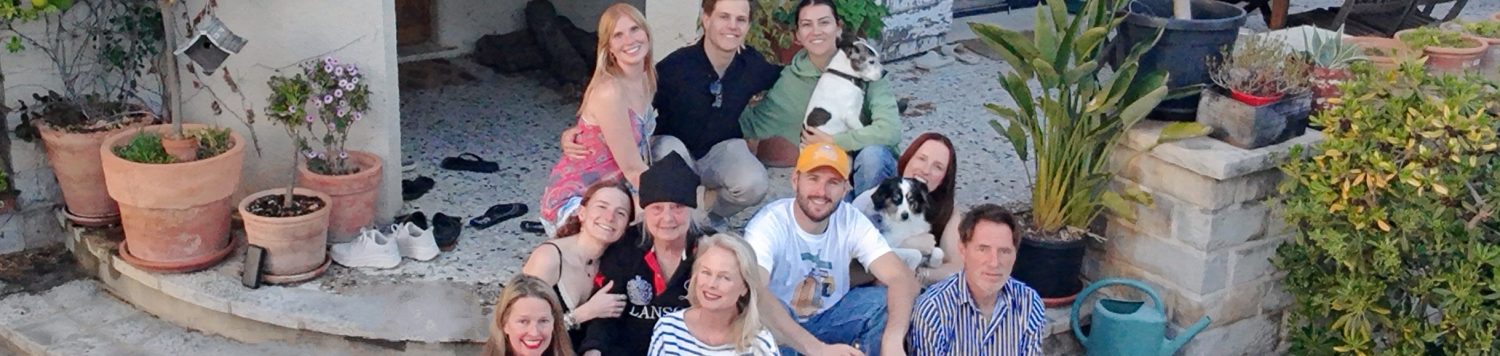
Fall is around the corner and the grapes are landing in the baskets. Day three of la vendange.
Grape harvest update: eight more helping hands have arrived, two of which belong to my mom… stay tuned.
cuve (koov) noun, feminine
: vat
: tank, mash tun; cistern
Hear today's word and this example sentence: une cuve. On met les raisins dans la cuve.
Download cuve.wav. Download cuve.mp3
Photo (click to enlarge): Well Wishers leave their signature on the cement cuves in our cellar.
This
is as good a time as any to begin a "Questions" section. Dorénavant,*
I, or my family, will try to answer the occasional question. This week, a few of
these types of inquiries arrived via the comments and inbox:
"Kristin,
forgive the ignorance of this question. Is it normal to bottle last year's
harvest just in time to clear the space for the current year's
grapes?"
Thanks, Mike, for your question, which is in response to the chiffon post:
"Yesterday, beneath a pouring Provencal sky, we bottled our 2007
Mistral: all 10,300 examples of it (and just in time to clear the cellar for
next week's incoming grapes!). "
Here is Jean-Marc's answer in
French (and English):
"C'est pas que c'est normal, c'est que le vin était
prêt à être mis en bouteille et qu'il fallait libérer quelques cuves pour
recevoir la nouvelle vendange."
It isn't that it's not normal, it's just
that the wine was ready to be bottled and it was necessary to free up a few
of the tanks in order to receive the new harvest.
Pile ou Face
One question down and one to go… this one, from Diane, and it is your turn, dear reader, to answer:
I heard this French phrase, "pile ou face," recently in a movie (A Good Year
with Russel Crowe). I looked up each individual word and was a bit confused.
Am I wrong or is "face" the word "heads" in English and is "pile" the reverse
side or "tails" ? So are the French literally saying " to play tails or
heads"? Or, am I wrong and pile does mean heads? Just a semantic question
nevertheless, but I would like to know the answer if possible.
Answers to the above question, and comments on today's post, are welcome. Please use the comments box and thanks in advance.
~~~~~~~~~~~~~~~~~~~~~~~~References~~~~~~~~~~~~~~~~~~~~~~~~~~~~
dorénavant = from now on
Partial harvester profile (photo, left): this is Erin (Australia). She studies wine science and knows how to measure the sugar content in a grape. She's funny, wears cool t-shirts, and got over it quickly when her computer was stolen (not two weeks ago, out of her hotel room). Rolling up her sleeves–and using Jean-Marc's PC–she re-typed her entire term paper–from memory!!!–and turned it in on time to begin the harvest with us. She'll turn 24 tomorrow. Please wish her a joyeux anniversaire! PS: I know, she's beautiful. But she's also taken. More about him in a future harvester profile.
Discover more from French Word-A-Day
Subscribe to get the latest posts sent to your email.
Nous vous souhaitons une bonne anniversaire!
Salut, Winn and Denise
In response to Diane..yes “pile ou face” translates into what we call “heads or tails”. Pile generally means the reverse or back side of the coin (with the front side having the “head”). Pile does not traslate into any kind of tail. The interesting question is why we call it tails in English. There is no tail on the back of any American coin (or any coin from any country that I know of).
Stacey: According to the Dictionary of Phrases and Fables, the definition of “heads or tails”: “Guess whether the coin tossed up will come down with headside uppermost or not. The side not bearing the head has various devices, sometimes Britannia, sometimes George and the Dragon, sometimes a harp, sometimes the royal arms, sometimes an inscription, etc. These devices are all included in the word tail, meaning opposite to the head. The ancient Romans used to play this game, but said, “Heads or ships.”
Oui, “pile ou face” est une expression littérale: http://www.wordreference.com/fren/pile%20ou%20face
Et, quelques expressions avec pile dont une est pile ou face: http://dictionnaire.mediadico.com/traduction/dictionnaire.asp/expression/pile/2007
Hi Kristen.
My students in French class are enjoying your beautiful pictures and stories very much. Bon courage! Do you welcome travelling students to help out with the harvest next Fall?
Julie Schorr
San Diego, Ca
Here is what Le Petit Robert says:
Côté d’une médaille, d’une monnaie qui porte l’écusson et le chiffre (opposé à face). fi revers. Loc. PILE OU FACE (sans article) : jeu de hasard consistant à jeter une pièce en l’air après avoir parié sur quel côté elle tombera. Jouer qqch. à pile ou face. « il décida de jouer son départ à pile ou face [º] il prit la pièce de quarante sous, pile je pars » (Sartre).
Bon anniversaire, Erin. Aujourdhui, la reine, c’est vous.
Loved the movie… actually saw it again 2 or 3 days ago and for some reason made me think of you Kristen.
In Spanish ‘pile ou face’ is translated ‘cara o cruz’ (cara=face, cruz=cross)… in English makes sense the tails part… but cross in Spanish does not… if I find an explanation I’ll share it with you.
Merci et a bientot.
The word ‘cuve’ refers to a vat, not a tank, and is related to the vinter’s term, ‘cuvee’, or ‘contents of a vat’, to denote a wine that is blended from either different grapes or from mixing of vineyard stock. ‘Vin du cuvee’ refers to a wine produced from the first pressing.
While cistern refers to a container holding liquide, it has historically denoted a tank or barrel, either above or below ground level, used to catch and store water, usually rainwater or a reservoir for pressed oils for cooking. It’s derived from the Latin term, cisterna (a box) or Greek (a basket).
Bon anniversaire, Erin, from a fellow Aussie living in the Limousin, and enjoying the fruitier wines of the south rather than the thin local Bordeaux stuff!
Intuit: thank you for the “vat” translation (instead of my “tank”). I’m still kicking myself for mixing that up. Good thing Jean-Marc is the winemaker around here, otherwise those cuvées might taste like petrol.
Diane,
Hope you read the book too. It is a far different story, a question of reading heads or tails. Both can be interesting taken ontheir own.
Carla Bruni aka Mme Sarkozy chante joliment,
“Je suis ton pile, tu es mon face” dans sa chanson, “Le toi du moi.” Elle chante ces petits mots dans le masculin.
Rosalie – des Rocheuses du Colorado
Hi Kristin,
I’m not sure this is the correct place to put this, so please forgive me if it is not.
Your Canadian readers who don’t already know about it will be pleased to hear about the wonderful CBC Radio program called “C’est la Vie,” which has a charming segment called Word of the Week, where French words and phrases are explained to the English speaker, who is then shown how to use it in a sentence.
I’ll just paste in some information from the CBC website so those interested can find it; there are podcasts for anyone listening outside Canada:
The popular “Word of the Week” segment features Johanne Blais of the Canadian Bilingual Dictionary project and tells tales about distinctly Canadian French words and phrases. This is a feature listeners say has enriched their vocabularies and given them new ways to express themselves, and is one of the programs most popular features.
http://www.cbc.ca/programguide/program/cest_la_vie
Broadcast time:
Sundays at 7:30 p.m. (8:30 AT, 9:00 NT) on CBC Radio One
Tuesdays at 11:30 a.m. (12:00 NT)
You can now also download the C’est la vie podcast as well as the Word of the Week podcast.
Word of the Week on CD
CBC Radio is proud to announce that the popular Word of the Week segment of C’est la vie is now available on CD. The 2 CD set is called “Word of the Week, Volume 1.”
bonne anniversaire et bon vendage!!! j’espere que je peut etre la bas maintenant avec vous! l’annee prochaine! 🙂 gros bisous et a votre sante! laura
“C’est pas que c’est normale…” would translate as “It’s not that it -is- normal,” right? Normal enough, though, I guess, if the wine was simply ready! Bon anniversaire Erin!
G’day Erin and Happy Birthday from Tassie!
Eriu – Hope your having a lovely day. You sure do look at home amongst those vines. Are you fingers stained yet?
In Australia the older,non decimal coins (phased out in the sixties) included a large penny. On this coin there was a royal head on one side and Kangaroo in full flight on the other side. So it6 can be said that there-by hangs a tail .Two of these coins are still used in a head/tails gambling game called two-up which is well known in New Zealand and Austalia
Happy birthday, Erin! Sept 11th is my birthday, too. Wish I were in France to celebrate it, picking grapes or not!
Hope you had a great birthday!!! Not a bad effort on your essay. Lot of love
Hello Kristin
Re ‘cuve’:
Hear today’s word (…check back later for the sound file…)
I have been checking back and checking back and it’s getting later and later! I know you are busy, but I would love to hear a francophone pronounce Cuve. Please! And happy birthday to Erin from another Aussie.
Merci bien Kristin et Jean-Marc!
Christine
Pile c’est heads et face c’est tails!
Une lectrice française