
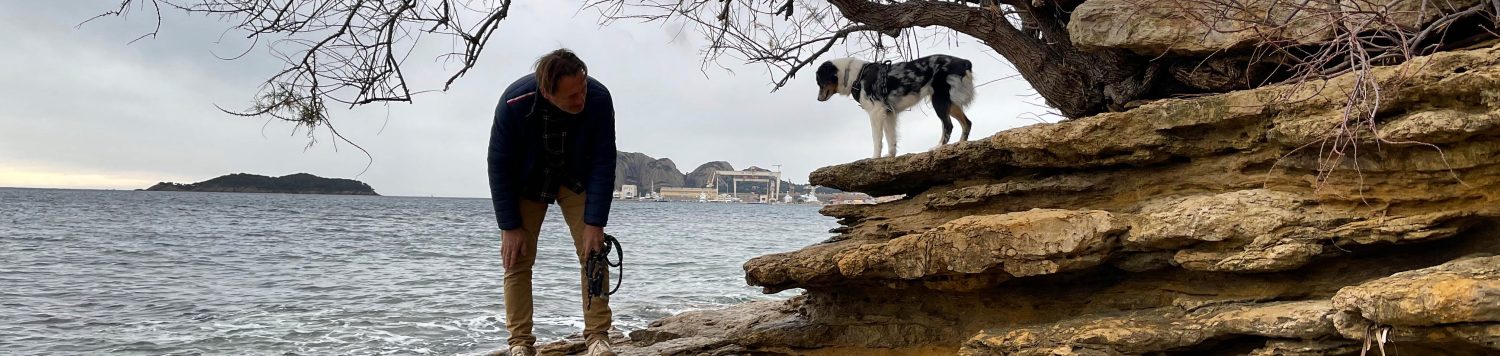
Not many medicinal plants in here… but you’ll find some in today’s story, below. Photo taken In the town of Orange
I really enjoyed the book Petite Anglaise: In Love. In Paris. In Trouble.
If you love France and have ever dreamed of moving to the Hexagon, then you
might like reading about how one “Petite Anglaise” followed her Francophile
urgings and, rucksack on her back, traveled into the country, gradually built
her nest… and once and for all unpacked.
foliole
(fol-ee-ol) noun, feminine
leaflet, one in a number of tiny
leaves
…and, there seems to be a matching verb, “folioter”, which means
“to number
the “feuilles” or pages in a book”: to paginate (synonym =
feuilleter).
Listen to the French word
“foliole”: Download foliole.mp3 . Download foliole.wav
The Botanical Bouquet
He brought
me exotic acanthus, its flowery gray and white “tail” trailing from a plastic
sac… Looking inside, I saw more wild plants: chardon,*
bourrache,* marrubium, and something he’d sub-labeled “Paris Fog”. I peered
deeper into the bag’s recesses, my fingers pushing through the herbal jungle.
There was fennel, “patience,” “pastel,” and mélisse….* The leafy list went
on and on.
I could not identify what I was looking at but listened to
Monsieur’s explanations, which he delivered almost as an apology. I would
observe, eventually and first hand, how he was forever excusing himself for
the knowledge which he wore like a thorny crown, there, above a beautiful
botanical mind. His gift or “don” as he called it, was passed down from his
grandfather, a paysan* like himself, and a man he never chanced to know. And
while Monsieur could identify hundreds of plants growing in Provence, and
even tell you their name in Provençal, he insisted that the information did
not interest others these days. “People prefer to sit in bars, drink beer,
and play the lottery.”
As Monsieur spoke to me I realized, with glee,
that I no longer sat in bars, drank beer, or played the lottery… and I hope
that’d somehow count me in as “interested party”.
This conversation
took place on Portalet street, a peripheric road running round our village
center. I had been close to dozing as I sat behind the fold-out table that
doubled as an author’s booth, while book fair traffic filed past…. That’s
when Monsieur strode up in a freshly pressed shirt, appropriately the color
of asparagus, sack in hand. I’d seen him earlier that day when I thanked him
for the information that he had given me regarding a certain fleur rustique,*
one I had been eyeing on every French curb and in every rock
garden.
There I now stood, beneath the giant plane trees, unrolling
stalks, leaves, and different plant “breeds,” carefully setting aside the
humid newspaper which Monsieur had used to keep the botanicals fresh. Inside,
each wet wrapping, beside a stem or a stalk, I found a hand-written
explanation, in pre-war penmanship, authored by my septuagenarian
friend.
“That one you can plant,” he said, adding: “in a shady place….”
It will grow white flowers… “What’s its use?” I asked. Monsieur shrugged
his shoulders, repeating: “It will grow white flowers”. “Pretty white
flowers!”, I decided, promising to find a shady spot in my
garden.
“This one you can eat”… he offered. “Like spinach.” I looked at
the little brown foliole* leaves, no bigger than tears, and wondered how to
prepare them for the palate? The scribbled note read “Patience Officinale”
(a.k.a. “Monk’s rhubarb”). Hmmm…. pie! “I think I saw this growing in our
vineyard,” I realized, excitedly.
I studied the handwritten notes,
some included anecdotes. “Acanthe molle,” the first one had read. There were
definitions and trivia, too, like this one for the acanthus: “Emblème des
sculpteurs, artistes… Symbolise l’amour des arts…. sa feuille ressemble à
une patte d’ours…”* I glanced over at the plant’s leaves. Sure enough, they
looked like bear paws to me…. The note continued: “With these, the Greek
sculptor Callimaque (Callimachus) decorated the Corinthian columns in the
Roman temples. The church (here) in Sainte Cécile is decorated with
them….” I made a mental note to waltz over to our town’s chapel and look for
“bear paws” inside.
Next, I carefully rewrapped the plants, some
medicinal, some ornamental, some edible… all for which I was thankful. But
how to express such gratitude? Why not begin with an appropriate French verb
(perhaps “planter”)? And why not make up a flower name to offer in
return?
And so, like that, I planted a “Calico Kiss” there on Monsieur’s
cheek, right over the blushing
redness.
* *
*
P.S.: Here’s a book I just ordered: “Of People and Plants: The
Autobiography of Europe’s Most Celebrated Healer” …not sure how it will
read, though I did get the thumbs up from Monsieur, who has the same book in
French.
~~~~~~~~~~~~~~~~~~~~~References~~~~~~~~~~~~~~~~~~~~~~
le
chardon (m) = thistle; la bourrache (f) = borage; la mélisse (f) = balm;
le paysan (m) = countryman; la fleur (f) rustique = rustic flower; la foliole (f) =
leaflet; “Emblème des sculpteurs, artistes… Symbolise l’amour des arts….
sa feuille ressemble à une patte d’ours...”* = Emblem of
sculptors, artists… symbolizes a love of the arts… its leaf resembles a
bear’s paw.
~~~~~~~~~~~~~~Shopping~~~~~~~~~~~~~~~~
Organic
Borage herb 100 Seeds – Borage officinalis
Art
poster: Bouquet De Chardons by Vincent van Gogh
The
scent of Provence: Sauvage Fenouil Candle by Diptyque
Words
in a French Life: Lessons in Love and Language from the South of France
Discover more from French Word-A-Day
Subscribe to get the latest posts sent to your email.